
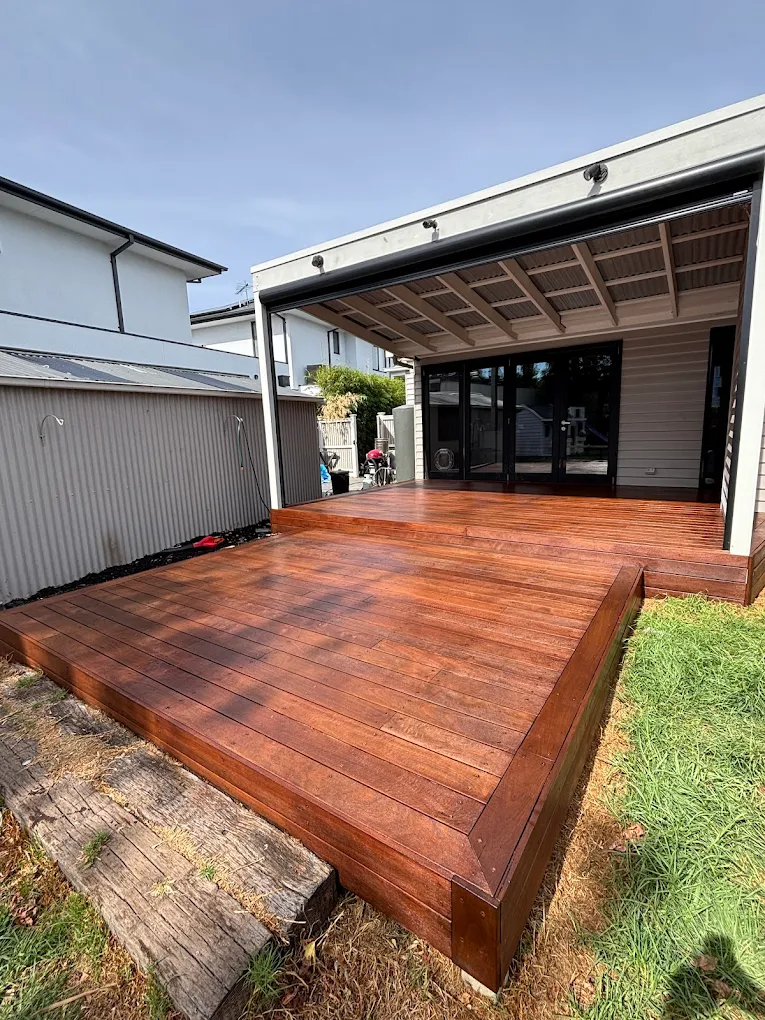
A deck that looked beautiful when it was first installed has a way of gradually becoming something you avoid looking at directly. The grey, weathered timber. The raised grain that catches bare feet in summer. The black mould sitting in the joints and shadow lines between boards. The flaking remnants of a coating that was applied years ago and never properly maintained between applications. I have restored decks across Bayside Melbourne — in Mentone, Mordialloc, Cheltenham, Parkdale, and Beaumaris — and the most consistent thing I hear from homeowners when I am standing on a deck that needs work is the same every time: “we should have done this two years ago.”
The good news about deck restorations is that most timber decks that look like they are beyond saving actually are not. Hardwood timber is extraordinarily resilient and what looks like permanent weathering and grey discolouration is almost always surface oxidation and biological staining that responds very well to proper cleaning and preparation. The condition beneath the surface grey is often sound, structurally solid timber that, once properly prepared and coated by an experienced team like The Paint Pimp, will look close to new and provide another ten to fifteen years of enjoyment before needing significant attention again.
This guide covers how to accurately assess whether your deck needs restoration or replacement, what the professional deck restorations process actually involves from start to finish, what coating options are available specifically for Bayside Melbourne’s coastal environment, and what a realistic cost looks like for a properly done deck restoration in 2026.
Assessing Whether Your Deck Needs Restoration or Replacement
This is the most important question to answer before any work begins and it is one that an experienced deck restoration specialist can answer accurately after a proper on-site inspection. The surface appearance of a deck — the greying, the mould, the faded or flaking coating — tells you very little about the structural condition of the timber framing system beneath it. Decks that look terrible on the surface are often structurally sound and excellent restoration candidates. Decks that look acceptable on the surface sometimes have significant structural deterioration in the framing and joists that is not visible without getting underneath and physically checking each member.
The inspection for a deck restoration assessment checks the decking boards individually for softness, splitting, and end grain checking that indicates moisture penetration and the early stages of rot. It checks the structural members — joists, bearers, posts, and any ledger attachment to the house wall — for the same signs of deterioration, which is far more serious structurally than surface board condition and cannot be addressed through restoration alone. It also examines connection hardware — joist hangers, post bases, and fixing screws — for corrosion that may have compromised the structural integrity of the whole deck system.
A deck where the boards have surface weathering and minor checking but the framing structure is sound is clearly a restoration candidate. A deck where multiple boards show through-softness and the framing joists are showing active rot at connection points is a replacement candidate regardless of how reasonable the surface boards appear from above. Being honest about this distinction at the inspection stage is what separates a genuine deck restoration specialist from an operator who will restore a deck that genuinely should have been replaced — leaving the homeowner with a freshly coated surface sitting on a compromised structure underneath.
What Professional Deck Restorations Actually Involve
Professional deck restorations in Bayside Melbourne follow a consistent process regardless of the deck’s size or timber species, with variations in product selection and technique depending on the specific timber type and its current condition.
The first stage is preparation — the most important and most time-consuming part of any quality restoration, and the stage that most budget operators rush or skip entirely. Preparation starts with a thorough clean using a professional timber deck cleaner — a mildly acidic solution that removes mould, algae, weathering greys, and any remnants of old coating that have not already flaked away naturally. This cleaner is applied, agitated methodically with a stiff brush to break down the biological and coating residue, and then thoroughly rinsed away. For decks with significant old coating residue that will not respond to chemical cleaning alone, a controlled low-pressure wash removes the softened residue without raising the timber grain in the way that aggressive high-pressure washing does.
After cleaning, the deck surface is carefully assessed for areas requiring mechanical preparation — raised grain from previous coating applications, splintered or roughened board surfaces from weathering, and any areas where boards have cup-warped slightly and left edges that catch on bare feet. A pole sander with appropriate grit paper removes these surface irregularities and opens the timber grain to properly receive the new coating system. This preparation stage is what most budget restoration operators skip or rush, and it is what determines how long the new coating will actually last before failing.
Once preparation is complete and the timber is clean, fully dry, and lightly abraded across the whole surface, the coating system is applied. The choice of coating depends on the homeowner’s preference for maintenance frequency, the species of timber being restored, and the deck’s specific exposure conditions. In Bayside Melbourne’s coastal environment, UV exposure intensity and salt-laden air from Port Phillip Bay are significant factors in product selection and long-term longevity.
Why Bayside Melbourne’s Coastal Conditions Make Deck Restoration Harder
Bayside Melbourne’s proximity to Port Phillip Bay creates specific environmental conditions that affect deck restoration outcomes in ways that inland Melbourne homeowners simply do not experience to the same degree. Salt air from the bay accelerates the breakdown of coating systems on all exposed surfaces. UV radiation intensity at sea level is consistently high. The combination of sea breezes, coastal moisture, and Melbourne’s variable rainfall creates cycling wet-dry conditions that test the flexibility and adhesion of any coating film season after season.
For decks in Mentone, Mordialloc, and Parkdale that face the bay directly or are within a few hundred metres of the coastline, coating selection needs to account for these conditions far more carefully than for inland applications. Premium exterior timber coatings with UV inhibitors and fungicide additives perform significantly better in coastal Bayside conditions than economy products, and the longevity difference between a quality product and a budget product is substantially greater in coastal environments than it is inland where conditions are far less aggressive on coating systems.
As a guide, the coating system options for Bayside Melbourne deck restorations fall into two main categories. Penetrating oils soak into the timber and provide protection from within without forming a surface film that can peel or delaminate. Penetrating oils require more frequent reapplication — typically every two to three years in Bayside’s coastal conditions — but they are easier to maintain and tolerate minor areas of coating breakdown without the catastrophic delamination that film-forming coatings can experience. Film-forming coatings build a protective layer on the surface of the timber and last longer between full applications, but they require more thorough preparation when recoating because the new coating must bond to the existing film surface rather than to bare timber directly. The right choice depends on the timber species, the homeowner’s willingness to maintain the deck regularly, and the specific exposure the deck faces.
This is exactly the kind of detail that The Paint Pimp’s experienced team covers during every deck restoration assessment across Bayside. The same expertise and attention to preparation and product selection that goes into our interior painting and exterior painting work applies to every deck restoration project we take on.
Deck Restoration vs Replacement: The Cost Comparison
| Factor | Deck Restoration | Deck Replacement |
|---|---|---|
| Upfront cost | $1,500 – $5,000 | $8,000 – $25,000+ |
| Timeframe | 2 to 4 days | 2 to 4 weeks |
| Disruption level | Minimal | Significant |
| Result lifespan | 5 to 10 years with maintenance | 15 to 25+ years |
| Suitable when | Structure is sound | Structural failure present |
| Maintenance required | Yes — every 2 to 4 years | Yes — from year 3 onwards |
The financial case for restoration over replacement is compelling when the structure is sound, and for most Bayside Melbourne homeowners whose decks have been neglected cosmetically but not allowed to deteriorate structurally, restoration is the right call. The difference in upfront cost — typically $1,500 to $5,000 for a quality restoration versus $8,000 to $25,000 or more for a full replacement — is significant, and when a restoration is done properly with quality products over a well-prepared surface, it delivers five to ten years of good performance before requiring any significant attention again.
The important caveat is that the quality of the restoration determines the value of the investment. A deck that is poorly prepared and coated cheaply will need repeat treatment within two to three years, eliminating most of the cost advantage. A deck that is properly prepared and coated with quality products suited to Bayside’s coastal conditions should last five to eight years before requiring a maintenance coat — making the initial investment in quality work genuinely cost-effective over the medium term.
Property owners in Bayside Melbourne who also work with The Paint Pimp on commercial painting projects will recognise the same principle at work — proper preparation and quality materials cost more upfront but deliver significantly better value over time than cheap work that fails prematurely and needs repeating.
What Deck Restorations Cost in Bayside Melbourne in 2026
Deck restoration costs in Bayside Melbourne depend on the size of the deck, the extent of preparation required, the coating system selected, and whether any individual board replacement or structural repair work is needed alongside the coating restoration.
For a standard Bayside Melbourne residential deck of 30 to 50 square metres in reasonable to moderate condition, a professional restoration including full cleaning, proper mechanical preparation, and a quality penetrating oil or film-forming coating system typically falls in the $2,000 to $4,500 range. Larger decks, decks in poor condition requiring more intensive preparation, or those requiring individual board replacement as part of the restoration work will fall toward the higher end of this range or beyond it depending on the specific scope involved.
The cost that seems higher at the restoration stage consistently delivers better long-term value than attempting to paint over or cheaply coat a deck that has not been properly prepared. A deck that receives poor preparation and a cheap coating will need repeat treatment within two to three years — meaning the homeowner pays twice in a very short period. A deck properly prepared and coated with quality products in Bayside’s coastal conditions should last five to eight years before requiring a maintenance coat, making the initial higher investment in quality work the more economical choice over any realistic time horizon.
Homeowners across Sandringham, Beaumaris, Brighton, and Hampton who want to understand what their specific deck restoration will cost can request a no-obligation inspection and quote. The Paint Pimp assesses each deck individually rather than applying a standard formula, because the condition variables that drive cost differ meaningfully from one property to the next.
In Victoria, all painting and restoration contractors working on residential properties should carry appropriate public liability insurance. It is worth confirming this with any contractor before work begins. The Victorian Building Authority provides information on the obligations that apply to domestic building work and what protections homeowners have when engaging contractors for property maintenance projects.
Keeping Your Restored Deck in Good Condition Between Professional Services
The interval between professional deck restoration treatments can be extended meaningfully with straightforward maintenance that most Bayside homeowners do not do because nobody has explained why it matters in practical terms.
The most important ongoing maintenance task for a restored deck is an annual inspection looking for early signs of coating failure — areas where the oil or film-forming coating is beginning to grey out, joints where water pooling is occurring after rain, any areas where the coating has lifted or cracked at board ends. Catching these early and treating them with a touch-up coat before they become larger failures is the most cost-effective way to extend the service life of a professional restoration.
Keeping the deck surface clean between professional treatments also makes a meaningful difference. Salt residue, leaf litter, and biological growth accumulate faster on coastal Bayside decks than on inland decks, and allowing these to sit on the coated surface accelerates degradation. A seasonal wash-down with a gentle timber cleaner and a scrub brush removes these contaminants without damaging the coating and slows the rate of biological growth that degrades coating adhesion over time. This kind of straightforward maintenance costs almost nothing and meaningfully extends the interval before a full professional restoration treatment is needed again.
Conclusion
Deck restorations in Bayside Melbourne give homeowners a cost-effective way to extend the useful life of a timber deck that has weathered and lost its appeal, without the cost and disruption of full replacement when the structure underneath is still sound. The key to a restoration that lasts five to eight years rather than two to three is thorough preparation — professional cleaning, mechanical abrading, and addressing any structural issues — before any coating product goes on the surface. The homeowners who get the best long-term value from deck restorations consistently invest in quality preparation and quality products rather than looking for the cheapest way to make the surface look acceptable for a single season.
If your Bayside Melbourne deck is looking tired and you want an honest assessment of whether it is a restoration or replacement candidate, contact us at The Paint Pimp for an obligation-free inspection and quote. We will give you a straight assessment based on what we actually find on the day — and a clear, detailed quote based on what your deck genuinely needs to perform well for the next decade.
FAQs
Can all timber decks in Bayside Melbourne be restored or does old timber always need replacing?
Most hardwood timber decks in Bayside Melbourne that have simply weathered and been cosmetically neglected can be restored successfully. Spotted gum, merbau, blackbutt, and ironbark — the species most commonly used in residential decking across Bayside Melbourne — are extremely durable hardwoods that resist rot and insect damage far better than softwood species like pine. The decks that genuinely need replacement are those where the structural framing shows active rot at connection points, where multiple boards are soft through their full depth rather than just surface-weathered, or where the original construction had design flaws that allow water to pool and penetrate the structure over time.
How long do deck restorations last in Bayside Melbourne’s coastal environment?
With quality products properly applied over well-prepared timber, penetrating oil systems on Bayside Melbourne decks typically need a maintenance coat every two to three years and a full restoration treatment every five to eight years depending on exposure. Film-forming coatings last longer between applications but require more thorough preparation when recoating. The longevity of any coating system in Bayside’s coastal conditions is significantly better with quality products than economy options, and the preparation quality has a greater impact on longevity than the coating brand selected.
Should I sand my Bayside Melbourne deck before restoration or is washing enough?
For decks with smooth timber that has simply weathered and lost colour without significant old coating residue, thorough chemical cleaning followed by a light mechanical sand or abrasion to open the grain is the appropriate preparation. For decks with significant old coating build-up, raised grain, or splintered surfaces from weathering, more extensive mechanical preparation is needed before any new coating can be applied. Using high-pressure washing to strip old coating is generally not recommended for quality restoration work because it raises the timber grain significantly and can drive water into the structure. A professional restoration approach uses chemical preparation first, with mechanical methods following where needed on a surface-by-surface assessment.
Can I do my own deck restoration in Bayside Melbourne or should I use a professional?
Homeowners with good preparation skills and appropriate equipment can achieve reasonable results on deck restoration as a DIY project, particularly on smaller decks in moderate condition. The practical limitations of DIY are usually in preparation quality — accessing appropriate cleaning and sanding equipment, achieving even preparation across the whole deck surface, and recognising areas that need specific individual attention — and in coating application consistency across a large surface area. Professional deck restorations consistently deliver better longevity primarily because the preparation is more thorough than most homeowners will invest time in achieving on a DIY basis.
What is the best time of year for deck restorations in Bayside Melbourne?
Autumn and spring are the most suitable seasons for deck restorations in Bayside Melbourne. Moderate temperatures allow coating products to cure properly, UV intensity is lower than in summer reducing the risk of coatings drying too quickly during application and leaving brush or roller marks, and the risk of rain interrupting the work is more predictable than during Melbourne’s changeable summer afternoons. Deck restorations can be completed in summer if the work is planned to avoid the hottest part of the day on direct sun-facing decks, and in winter if extended dry periods allow sufficient drying and curing time between preparation and coating stages.